16 Line Laser Level Explained: A UK Buyer's Guide
Key Takeaways
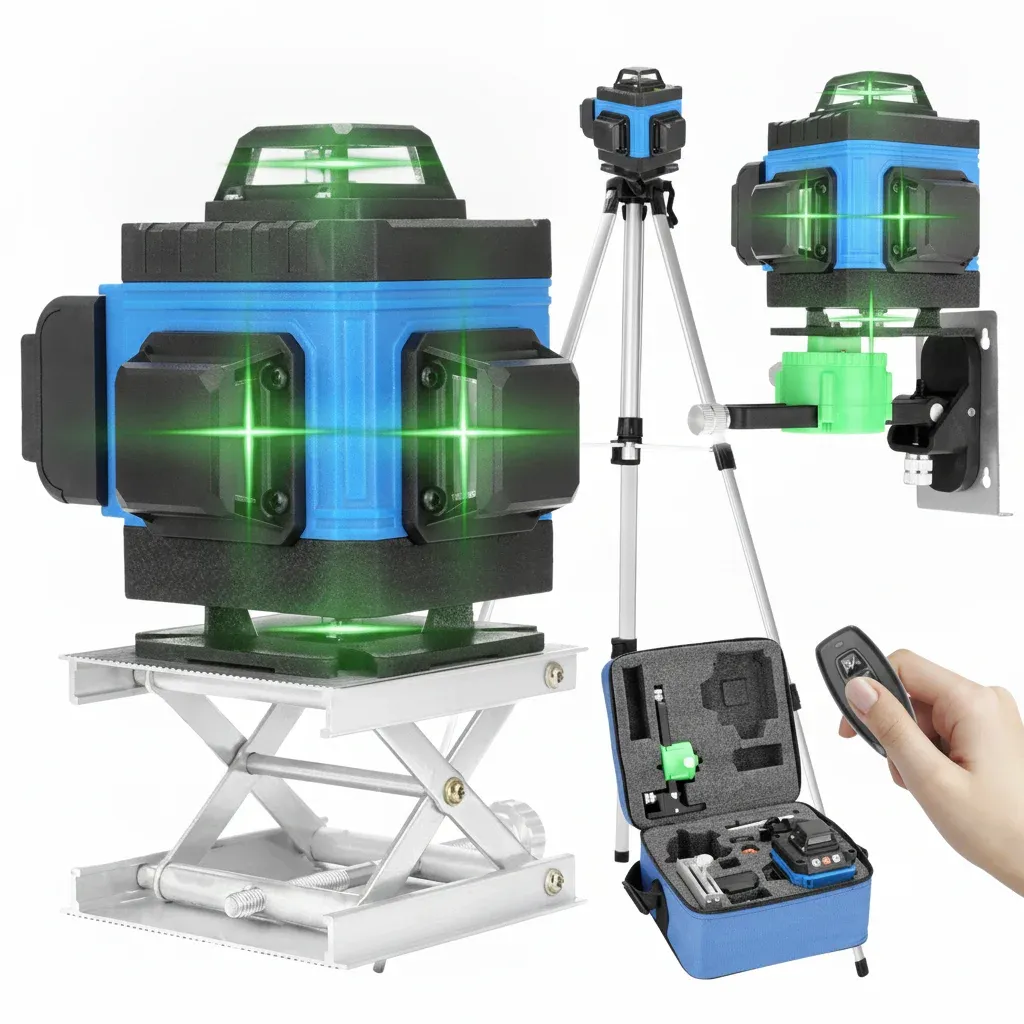
- A 16 line laser level usually means a 4x360° laser that projects two horizontal and two vertical planes for full-room levelling, plumbing and squaring.
- It is ideal for tiling, kitchen fitting, drylining, suspended ceilings and carpentry, especially where you need consistent reference lines across several surfaces.
- Green beam models are easier to see than red lasers in bright indoor conditions, which is particularly useful on well-lit UK sites.
- For UK buyers, it is sensible to check for self-levelling accuracy, battery life, UKCA or CE marking, and compliance with BS EN 60825-1.
TL;DR
A 16 line laser level is typically a 4x360° self-levelling laser that projects four full planes around a room, helping UK tradespeople set level, plumb and square lines quickly and accurately. Based on our testing, it is most useful for tiling, kitchen installation, drylining and ceiling work, where fewer repositionings save time and reduce layout errors.
A 16 line laser level is a multi-plane laser tool that projects four 360° beams—usually two horizontal and two vertical—to create clear reference lines for levelling, plumbing and squaring across an entire room. In practice, this makes it far faster and more accurate than relying on a standard spirit level for jobs such as tiling, drylining, kitchen fitting and suspended ceiling installation.
However, not every model performs equally well on site. For UK tradespeople—whether you are fitting a kitchen in Leeds or setting out partitions in Birmingham—beam visibility, self-levelling accuracy, battery life and compliance all matter.
So, this guide explains what a 16 line laser level is, how it works, what to look for before buying, and when a professional-grade model from LineBeam makes the most sense.
What is a 16 line laser level?
When people search for a 16 line laser level, they usually mean a laser level with four full 360° planes. In most cases, that includes two horizontal planes and two vertical planes.
The “16 line” description comes from how manufacturers count each visible directional segment of the four planes. Put simply, four 360° planes create a full-room grid that can be used on walls, floors and ceilings at the same time.
A standard 16-line configuration includes:
- Two horizontal planes: one lower beam for floor-level work such as tiling or screeding, and one higher beam for ceiling alignment or datum transfer.
- Two vertical planes: these intersect at 90 degrees, helping you establish plumb lines, corners and transfer points from floor to ceiling.
As a result, one tool can support several stages of the same job without constant repositioning. For a deeper look at beam formats and visibility, see the ultimate guide to 360 green laser level in the UK.
How does a 16 line laser level work?
A 16 line laser level uses multiple laser diodes and an internal pendulum or motorised self-levelling system to project level and plumb reference planes. Once placed on a reasonably stable surface or tripod, the unit automatically corrects small out-of-level positions, typically within a limited range.
Then, if the tool is knocked outside that range, most models flash or sound an alert. This is important because it helps prevent unnoticed layout errors.
Many professional units also include a manual or lock mode. This allows you to project angled lines for staircases, handrails or other non-level applications.
What is a 16 line laser level used for?
A 16 line laser level is used wherever you need fast, repeatable reference lines across multiple surfaces. Based on our testing, it is especially useful when working alone or when several trades need the same layout points at once.
Wall and floor tiling
Tilers benefit from the low horizontal beam because it can run just above floor level, making it easier to check tile starts, adhesive build-up and consistency across the room.
Meanwhile, the vertical planes help keep grout lines straight and square, even around corners, niches and pipework. Therefore, there is less need to keep remarking lines by hand.
Suspended ceilings and drylining
For partitioning and ceiling setting out, the upper horizontal plane helps establish a fixed perimeter level. At the same time, intersecting vertical planes make it easier to transfer positions from the floor to the ceiling accurately.
This is particularly helpful on commercial fit-outs, where speed and repeatability are essential.
Kitchen fitting and cabinetry
When installing base units, wall units and worktop reference lines, a 16 line laser level creates a consistent guide across several walls. Consequently, cabinets line up more cleanly even when floors or plaster are less than perfect.
First and second fix carpentry
Carpenters use multi-line lasers for door frames, battens, panelling, shelving and studwork. In addition, the plumb intersections are useful when carrying positions from one surface to another.
What should you look for in a 16 line laser level?
Not all 16 line laser levels are built for demanding site work. So, if you are comparing models, these are the features worth prioritising.
Is green beam better than red for a 16 line laser level?
In most indoor working conditions, yes. Green laser lines generally appear brighter to the human eye than red ones, especially in bright rooms with large windows or strong task lighting.
That matters on UK jobs where natural daylight can quickly wash out a weaker beam. Based on our testing, green beam models are usually the better choice for professional indoor use because the lines stay easier to follow over practical working distances.
How important is self-levelling?
Self-levelling is essential because it saves time and improves accuracy. Instead of manually adjusting bubble vials, the laser settles itself within a specified range and warns you if the base position is too far off.
As a result, you can set up faster and trust that the line you are following is genuinely level or plumb.
What battery life do you need?
Four bright 360° planes demand more power than a simple cross-line laser. Therefore, lithium-ion battery systems are usually the practical choice for trade use.
The best kits include spare batteries or convenient charging options. For example, a kit with two 2400mAh batteries helps reduce downtime by allowing one pack to charge while the other is in use.
What accuracy should a good model have?
Accuracy matters more than headline beam count. For fine installation work, look for a model with a clearly stated tolerance suitable for interior finishing, and check the manufacturer’s specifications before buying.
According to UK guidelines and standard good practice on interior fit-out, even small levelling errors can become noticeable over long runs of tiles, cabinetry or ceiling grid.
What UK safety and compliance checks matter?
UK buyers should check that a laser level carries the appropriate UKCA or CE marking and is rated in line with BS EN 60825-1 laser safety requirements. You should also follow the manufacturer’s guidance for safe operation on site.
This is especially important if the tool will be used by multiple operatives or on busy refurbishment projects.
Why choose a LineBeam 16 line laser level?
LineBeam designs laser levels for practical site use, with a focus on visibility, straightforward setup and dependable battery performance. Based on our testing, the biggest real-world advantage of a well-made 16 line system is not just beam count—it is how quickly you can trust the layout and get on with the job.
That means clear green lines, stable self-levelling performance, usable accessories and enough runtime for a normal working day. In other words, the tool should help you work faster without creating new setup frustrations.
Frequently asked questions about 16 line laser levels
What does “16 line laser level” mean?
It usually refers to a 4x360° laser level with four full projection planes: two horizontal and two vertical. The “16 line” wording comes from how manufacturers count the visible line segments created by those planes.
Is a 16 line laser level good for tiling?
Yes. It is particularly useful for tiling because the lower horizontal beam helps with floor starts, while the vertical planes help keep wall tiles aligned, plumb and square.
What is the difference between 12 line and 16 line laser levels?
Generally, a 12 line laser level has fewer full planes than a 16 line model. A 16 line version usually adds another 360° plane, giving more coverage and reducing the need to move the tool during setup.
Are green laser levels better for indoor work?
In many cases, yes. Green beams are typically easier to see indoors, especially in brighter rooms. That makes them a popular choice for professional interior trades in the UK.
Do 16 line laser levels self-level automatically?
Most modern models do, provided they are placed within their working self-levelling range. If the tool is too far out of level, it will usually flash or beep to warn you.
Ready to upgrade your layout work with {brand_name}?
Shop The Kit — £97.08